
Farsightedness (hyperopia)
causes, symptoms and treatments
Farsightedness, or hyperopia, is a refractive error in which you see blurry up close, while you can usually see sharply at a distance. Worldwide, about 10 to 25% of the population has hyperopia. People with farsightedness need a plus prescription: glasses or lenses with a positive correction. Fortunately, there are effective treatments, such as laser eye surgery or lens implants, that offer permanent solutions. Farsightedness is an eye condition in which the eye does not refract light enough, so the image falls behind the retina.
What is farsightedness (hyperopia)?
Farsightedness (hyperopia) is an eye condition in which the eye does not refract light enough, so the image falls behind the retina instead of on it. This happens because the eye is too short or the refractive power of the cornea is too weak. In medical terms it is a refractive error, which can be corrected with glasses, contact lenses or an eye treatment such as lens implantation or laser eye surgery.
A distinction is made between latent and manifest hyperopia. The younger the patient, the greater the latent hyperopia: in young people the eye can still compensate by itself by tensing the lens. As you get older, this ability to adapt decreases and the farsightedness becomes more noticeable. That is why people sometimes say “farsighted people see better at a distance than up close”, but they too will eventually have trouble seeing at a distance, depending on their age and the degree of hyperopia.
What causes farsightedness?
Farsightedness is caused by a combination of anatomical and age related factors. An eye that is too short is the most common cause. A normal eye is about 23 millimetres long. With farsightedness the eye is shorter, so the light falls behind the retina. In addition, a cornea or lens with too little refractive power can cause the same problem: the cornea is too flat or the lens is not curved enough.
Heredity also plays a role in farsightedness: if one or both parents are farsighted, you are more likely to develop farsightedness. Many children are born farsighted, but some grow out of it as the eye grows and becomes longer.
Later in life, farsightedness gets worse because the eye is less able to focus. The lens of the eye becomes stiffer and the ciliary muscle, which changes the shape of the lens, is less able to make the lens more convex. As a result, the eye is less able to adjust to focus up close. Farsightedness can occur in combination with a cylindrical error (astigmatism).
What are the symptoms of farsightedness?
Do you recognise these complaints? Then you may be farsighted:
- Blurred vision up close: difficulty reading, especially small print or text on screens
- Tired eyes after reading or working at close range for a long time
- Headaches caused by the constant effort to focus
- Difficulty concentrating on tasks that require close vision
- Fluctuating vision: your vision switches from sharp to blurry, especially when reading
A natural response to farsightedness is that the eyes squint to focus (accommodation of the eye). As a result, most light enters through the centre of the eye, where refraction is less strong. This still allows you to see sharply. As you get older, the eye loses this ability to focus and the farsightedness gets worse. In young people the lens of the eye can still deliver more than 2.75 dioptres of focusing power, but in older people this is no longer possible and a correction will be needed.
How common is farsightedness?
Farsightedness is a common eye condition worldwide. About 10 to 25% of the world population is farsighted to a greater or lesser degree, which amounts to more than 1 in 4 people. The prevalence varies depending on age, genetic factors and environmental conditions.
In the Netherlands, the prevalence of farsightedness is comparable to that in Belgium. Farsightedness can manifest itself at any age, but is common in children. Untreated farsightedness in young people can lead to learning difficulties and reduced academic performance, which underlines the need for regular eye examinations and early detection. However, many children grow out of their congenital farsightedness as the eye grows.
Which treatments are available for farsightedness?
In most cases farsightedness can be corrected well, because the cause, an eye that is too short or a lens that is too weak, can be addressed in a targeted way. The treatment focuses on correcting the refraction of the eye, so that light rays come together exactly on the retina again and you see sharply both up close and at a distance. Depending on the severity of the condition, your age and your lifestyle, you can choose from various options: from simple glasses or contact lenses to a permanent laser eye treatment.
Temporary solutions
Glasses or contact lenses with plus lenses (positive correction) correct the refractive error, so that light falls on the retina again. Reading glasses or multifocal glasses offer a simple and immediate solution for farsightedness, but they do make you dependent on an aid. The prescription for farsightedness is expressed as a positive spherical number, for example S +2.0.
Permanent solutions
Laser eye surgery (LASIK, PRK, LASEK) reshapes the cornea, so that light rays fall on the retina again. This treatment achieves good, permanent results and in principle makes glasses or contact lenses unnecessary. The treatment is performed under local anaesthesia, so you feel no pain but some pressure. Recovery is fast: often you can function normally again the next day.
An alternative permanent solution is the placement of lens implants (ICL). An artificial lens is implanted in the eye to correct the refractive error. This treatment is particularly suitable for people for whom laser eye surgery is not possible, or whose farsightedness is too strong for other treatments.
Whether you are eligible for laser eye surgery for farsightedness depends on the health of your eyes (no eye diseases such as cataract or glaucoma) and the stability of your prescription (stable for at least 1 year). A free eye assessment can determine this. Test online now whether you are suitable using our tool.
What is the difference between farsightedness and other eye conditions?
Farsightedness (hyperopia) means that you see blurry up close, but usually sharply at a distance. This is in contrast to:
- Myopia (nearsightedness): you see blurry at a distance, but sharply up close
- Astigmatism (cylindrical error): you see blurry or distorted both at a distance and up close due to an irregular cornea
- Presbyopia (age related farsightedness): you see blurry up close because your ability to focus decreases after the age of 40
- Cataract: your vision becomes cloudy due to clouding of the lens of the eye
Presbyopia is a natural ageing process that affects almost everyone after the age of 40, while farsightedness is a refractive error that can exist from birth. It is important to know this difference, because the treatments can differ.
What are the risks of untreated farsightedness?
Farsightedness can get worse if it is not corrected. Especially later in life, the focusing ability of the lens decreases, which makes the complaints worse. Untreated farsightedness leads to:
- Constant eye strain and fatigue during close work
- Headaches and difficulty concentrating
- In children: learning difficulties and reduced academic performance, because the whiteboard or reading material is blurry
- Squinting (strabismus) in children with high farsightedness, because the eyes have to work extra hard to focus
In children, early detection of farsightedness is especially important. A child cannot always put the complaints into words, so untreated farsightedness can go unnoticed. Regular eye examinations are therefore recommended, especially if farsightedness runs in the family.
How is farsightedness diagnosed?
Farsightedness is diagnosed through an eye examination by an optician or ophthalmologist. During this examination, the refraction of the eye is measured with a refractometer or autorefractometer. The length of the eye is also measured, because an eye that is too short is the main cause of farsightedness. A normal eye is about 23 millimetres long; with farsightedness the eye is shorter.
In children, cycloplegic drops are often used to switch off focusing, so that latent hyperopia becomes visible and the actual refractive power can be measured accurately. This is important because young children, by focusing, appear to be less farsighted than they really are. Without cycloplegic drops, farsightedness can be underestimated, leading to an incorrect diagnosis and treatment.
It is advisable to have children checked every year, especially if one or both parents are farsighted. Early detection makes it possible to correct farsightedness in time and to prevent complications such as learning difficulties, strabismus and amblyopia (lazy eye).

How much do you spend on glasses and contact lenses
Do you spend a lot on your glasses or contact lenses? See here how much money you save with laser eye surgery. Take the test!
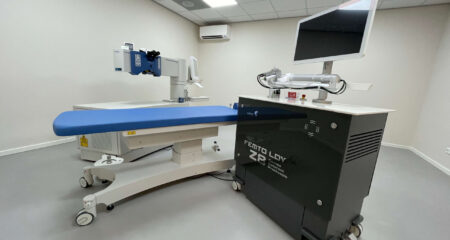
Our laser eye surgery equipment
Our advanced eye equipment is extremely precise and is used in laser eye clinics all over the world.
