

What is a refractive error?
With normal vision, light reflected by an object enters the eye through the cornea. The cornea bends (refracts) these light rays towards the eye’s natural lens, where they are bent again to focus on a sharp point on the retina. The retinal cells convert the light rays into electrical impulses that are sent to the brain (via the optic nerve) and processed into an image. Refractive errors occur when the eye is not perfectly shaped, so that light rays are not focused correctly on the retina.
Common refractive errors
All refractive errors affect the eye’s ability to see clearly at different distances. However, the way vision is affected, and the associated symptoms, vary considerably between the different types of refractive error. In general, the eye’s ability to focus light is influenced by the shape of the cornea, the curvature of the lens and the length of the eye.
What is nearsightedness?
People with nearsightedness (myopia) can see nearby objects clearly, but have difficulty focusing on objects that are far away. Nearsightedness usually occurs when the cornea or lens is too curved and bends light too strongly, when the eye is too long, or as a result of a combination of these factors. As a result, light rays focus in front of the retina instead of on it.
Nearsightedness usually develops in early childhood and can worsen with age as the shape of the eye changes over time. Excessive screen time and not spending enough time outdoors can lead to more severe cases. Nearsightedness usually keeps getting worse until someone is in their early twenties. For some people it can worsen even after that.
What is farsightedness?
Farsightedness (hyperopia) is a condition in which distant objects can be seen clearly, but nearby objects appear blurred. This usually happens when the cornea (or lens) is less curved than normal, the eye is too short, or a combination of these two factors. The flattened cornea cannot bend light rays strongly enough, which means that the light focuses behind the retina instead of directly on it.
Farsightedness can occur at any age, but often gets worse after the age of 40.
What is astigmatism?
Astigmatism is characterised by blurred or distorted vision, usually at all distances. Astigmatism occurs when the cornea is not perfectly round (i.e. it is shaped more like a rugby ball than a football). As a result, light rays passing through the cornea are bent unevenly and do not focus on a single point on the retina.
Astigmatism is a common diagnosis and most people have some degree of corneal asymmetry. Although people with mild astigmatism may not know they have it until they have a regular eye examination, very severe cases can result in highly distorted vision, as if you are looking in a funhouse mirror.
What is presbyopia?
Presbyopia (age-related farsightedness) develops gradually over time as the eye’s lens becomes stiffer and the muscles around the lens weaken. When you look at nearby objects, the lens in the eye changes shape to refract (bend) light more. Specifically, it becomes more convex. With age the lens loses this ability and as a result the image does not focus sharply on the retina.
Presbyopia causes progressive visual decline, usually between the ages of 40 and 65, and shows as blurred vision when doing close-up tasks such as reading. It is common for older people to develop presbyopia in addition to an existing refractive error such as nearsightedness or astigmatism.

What are the symptoms of a refractive error?
- Blurred or distorted vision
- Difficulty focusing on objects near or far
- Squinting to read
- Eye strain or fatigue
How are refractive errors diagnosed?
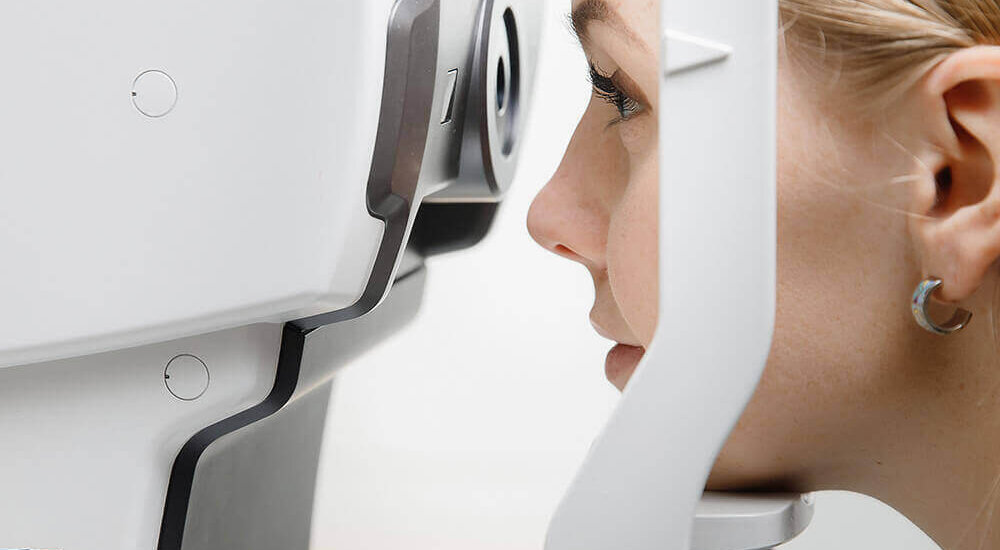
Refractive errors are diagnosed during a comprehensive eye examination with an optometrist or ophthalmologist.
During the examination a visual acuity test is carried out to check how clear your vision is. Refraction tests are also often used to check how well your eyes can focus light and whether corrective glasses or contact lenses are needed to adjust the refractive power.
Various other tests may also be included to determine the health and function of other parts of the eye. Since the shape of your eye and the strength of refractive errors can change over time, we recommend having a comprehensive eye examination every one to two years.
Living with a refractive error
Refractive errors can be corrected with glasses and contact lenses, or treated with laser eye surgery or lens implantation, depending on the severity of the refractive error and a person’s age.
Laser eye surgery involves permanently reshaping the cornea to adjust the refractive power, so that light can focus properly on the retina. This is generally suitable for people with nearsightedness, farsightedness and/or astigmatism and presbyopia. More information about laser eye surgery and the different types of treatment we offer can be found on our laser eye surgery page.
Lens implantation is another form of vision correction surgery that is usually reserved for people over 45 who are at risk of developing presbyopia or already experience it. This procedure involves replacing the eye’s natural lens with an artificial lens (known as an intraocular lens). For more information about the different lens options available, visit our page about lens implants.