
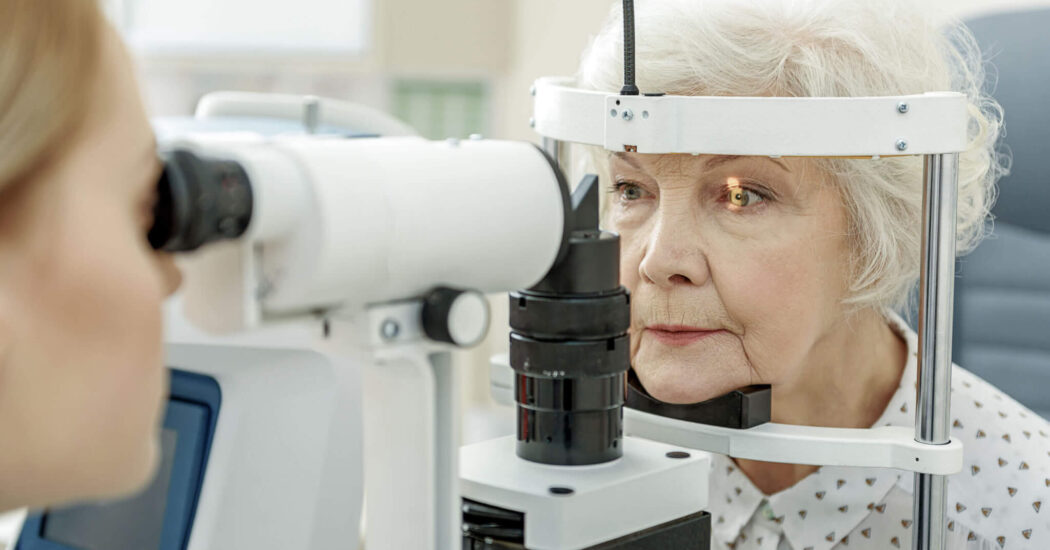
As we get older, our eyes change. We start to see less sharply and can become more susceptible to eye conditions that affect vision.
Difficulty reading
At the age of 40 or older, most people start to experience presbyopia, in other words, time for reading glasses. Research shows that people often wait far too long, spending years holding books at arm’s length or looking for large print editions. In addition to reading glasses, presbyopia can also be corrected with bifocal lenses or a monovision treatment, in which one eye is corrected for distance and the other eye for near vision.


No longer being able to see sharply
Some 20 years later your eyes can present a new challenge: cataract. While presbyopia is caused by a progressive loss of lens flexibility, cataract occurs when the lens becomes cloudy, dimming the image projected onto the retina.
This can occur in people aged 60 and older. The clouding progresses extremely slowly, and the only recognisable symptom is the gradual blurring of vision. Cataract is common and the solution is therefore routine: millions of cataract operations are performed every year. In this convenient procedure the cloudy lens is removed and replaced by a lens implant that stays clear for life.
If you would like to know more about ways to maintain clear vision for life, we invite you to schedule a personal, no-obligation consultation with one of our ophthalmologists.