
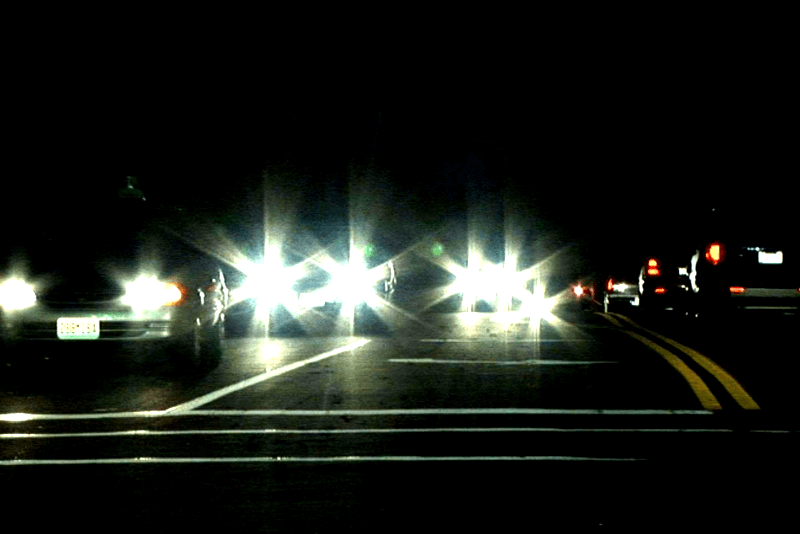
Halos and glare after laser eye surgery are almost a thing of the past. Learn how they are caused and read more about the symptoms and risk factors. In this blog you can also read how new technology has improved the treatments.
Halos and glare can occur when a focal point of light, such as a car headlight or the standby light of a video or TV in a dark room, has a glow or streaks of light around it. Terms such as “haze” or “scattering” of light can also be used to describe these visual effects. Many patients who underwent laser treatment in the early days experienced this glare as very troublesome and annoying.
In published studies from the early 1990s, about 85% of patients who underwent PRK (photorefractive keratectomy, the forerunner of LASIK and LASEK or TransPRK) reported these effects and 15% therefore decided not to have both eyes treated at the same time. (In early research studies there was often a significant interval between treating the two eyes.) These optical effects, or aberrations, are now almost a thing of the past with modern laser techniques.
Two causes of halos
Glare, halos, scattering and haze after a treatment have two main causes: one usually temporary and the other possibly longer lasting.
Immediately after the treatment, the cornea (the curved window at the front of the eye on which a contact lens sits) has to heal. While it does this, it is slightly swollen and scatters light, which is especially noticeable with light in a dark environment. The effect is like looking through a misted window or a piece of gauze. This is short lived and decreases within a few days or weeks as the swelling in the cornea subsides.
The second cause of these symptoms or aberrations, especially halos, is due to the fact that the shape of the cornea is changed by the laser treatment. This is of course how the process works in the first place: by changing the curvature of the cornea in a precise, computer controlled way to change the focus of light on the retina at the back of the eye. For example, in nearsighted patients the central cornea is essentially reprofiled by the laser to reduce or flatten its curvature.


The greater the refractive error, the greater the change in the curvature of the cornea and the greater the chance of induced aberrations. Two very important factors play a role in generating halos and other aberrations: the exact refractive error and the size of the pupil. A patient with small pupils may not be aware of halos at all, because the light from a car headlight, for example, is “less scattered” or focused more precisely through the area of the small pupil, while a patient with large pupils may be bothered by it a great deal.
It is therefore important that the treated zone in the central cornea ‘covers’ the maximum pupil size or is even somewhat larger. In the early days, lasers had limited treatment diameters, initially only four millimetres, hence the large number of patients who noticed halos. Modern ‘flying spot’ lasers can treat almost the entire cornea. And total treatment diameters of eight or nine millimetres, considerably larger than the average pupil size, are (fortunately) routine today.
In addition, very advanced tracking systems now ensure that the circular (or elliptical) treatment zones are precisely centred over the pupil, because poorly centred treatment zones can also cause troublesome optical aberrations. With current lasers, these halos and other aberrations have been virtually eliminated. Better still, modern treatments can even be applied safely many years after a previous procedure. At the Nationaal Oogcentrum we have the latest lasers and diagnostic systems, and our ophthalmologists are often able to improve or completely eliminate halos and glare caused by treatments with earlier systems.